

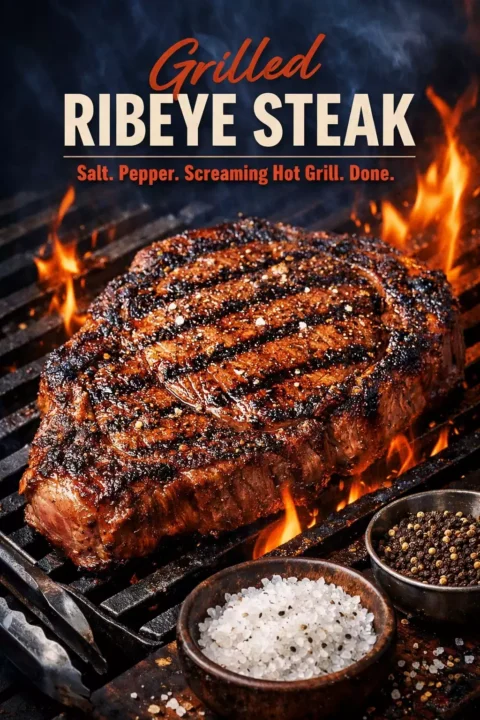
Grilled Ribeye Steak
Ribeye, salt, pepper, screaming hot grill. Two minutes per side. Rest it. Eat it. Steel beach picnic — that’s what we called it when we grilled steaks on the deck of a surfaced submarine. No fancy equ





Off the Galley Mike
Mike — Off The Galley
Six years as a Navy cook on submarines and destroyers, feeding 130 sailors from a galley the size of your bathroom. Now I cook the same big-flavor, no-nonsense food for my family of four — and share every recipe here. No culinary school. No fancy plating. Just real food that works, tested on the toughest critics afloat and the pickiest ones at home.
Grilled Ribeye Steak — Salt, Pepper, Screaming Hot Grill, Done
Ribeye, salt, pepper, screaming hot grill. Two minutes per side. Rest it. Eat it. Steel beach picnic — that’s what we called it when we grilled steaks on the deck of a surfaced submarine. No fancy equipment, no compound butter, no sous vide. Just good meat, salt, pepper, and fire. That’s still how I cook a ribeye, and it’s still the best steak I make.
Ribeye is the king of grilling steaks because of its marbling — the white threads of intramuscular fat that melt during cooking and baste the meat from the inside. A well-marbled ribeye at medium-rare is one of the most satisfying things you can eat.
Choosing the Steak
Buy a ribeye that’s at least 1.25 inches thick, ideally 1.5 inches. Thinner steaks overcook before a proper crust forms. Look for heavy marbling throughout the meat — the more white streaks, the more flavorful and juicy the result. Bone-in ribeyes (sometimes called cowboy steaks) have extra flavor from the bone and look more impressive. Boneless cook more evenly. Both are excellent.
USDA Prime has the most marbling. Choice is very good and more affordable. Select is lean and not ideal for grilling. If you can find Prime, buy it — the difference is worth the extra cost.
Ingredients
2 ribeye steaks (1.25-1.5 inches thick), kosher salt, coarse black pepper.
How to Grill It
Step 1: Season early
Salt the steaks generously 45-60 minutes before grilling, or the night before for the best results. The salt draws moisture to the surface initially, then the moisture reabsorbs, seasoning the steak deeply. Pat dry with paper towels right before grilling. Apply coarse black pepper just before the grill.
Step 2: Two-zone fire
Set up the grill with a hot zone (direct heat, as hot as possible — 500°F+) and a cool zone (indirect heat, no coals or burner off). This gives you a searing station and a finishing station.
Step 3: Sear
Place steaks over the hot zone. Don’t touch them for 2-3 minutes. Flip once. Sear the second side for 2-3 minutes. You should have a dark, caramelized crust on both sides.
Step 4: Finish
Move to the cool zone. Close the lid. Cook until internal temperature reaches 125°F for medium-rare (5-10 minutes depending on thickness). For thick steaks (1.5″+), the reverse sear is better — start on the cool zone until 115°F, then sear over direct heat.
Step 5: Rest
Remove from grill. Rest 5-10 minutes. The temperature will rise 5°F during rest. Slice against the grain if sharing, or eat the whole thing yourself — I won’t judge.
Steak Grades Explained
USDA grades matter more for ribeye than almost any other cut because the grading system is based primarily on marbling — and ribeye’s defining characteristic is its marbling. Prime grade has abundant marbling, is sold at high-end butchers and Costco, and produces the most flavorful, juiciest steak. Choice grade has moderate marbling and is what most grocery stores carry — it’s very good and significantly cheaper than Prime. Select grade has minimal marbling and is not recommended for grilling — the lack of fat means less flavor and a higher risk of drying out. If you’re spending the money and time to grill a ribeye, start with at least Choice grade. The difference between Choice and Select is dramatic.
Cast Iron vs. Grill
Both produce excellent ribeyes but through different mechanisms. The grill gives you smoky flavor, dramatic grill marks, and the romance of cooking over fire. Cast iron gives you a more even, aggressive crust because the entire surface contacts the hot metal. For the absolute best of both worlds, sear on a screaming hot cast iron skillet for 2 minutes per side, then finish in a 400°F oven for 5-8 minutes. But if I’m choosing one method, it’s always the grill — the smoke flavor and the experience of cooking outside can’t be replicated on the stovetop.
The Cost-Per-Impression Argument
A quality ribeye costs $15-25 per steak depending on grade and thickness. That sounds expensive until you compare it to a steakhouse, where the same steak costs $50-75 before sides, drinks, tax, and tip. Grilling a ribeye at home produces steakhouse-quality results at a third of the price. It’s one of the best value propositions in home cooking — high-impact, low-effort, and universally impressive.
Temperature Guide
Rare: 120°F pull, 125°F final. Medium-rare: 125°F pull, 130°F final. Medium: 130°F pull, 135°F final. Medium-well: 140°F pull, 145°F final. Well-done: please reconsider, but 150°F pull, 155°F final.
The Butter Finish
Optional but incredible: place a pat of butter on the steak during the last minute of cooking or immediately after pulling from the grill. The butter melts over the hot surface and creates a rich, glossy sheen. Compound butter (butter mixed with garlic, herbs, or blue cheese) elevates this further.
Don’t Press the Steak
Do not press the steak with a spatula while cooking. Pressing squeezes out the juices — the exact opposite of what you want. Place it on the grill and leave it alone until it’s time to flip. One flip. That’s it.
Serve With
Grilled corn, potato salad, coleslaw, a simple green salad, or baked potatoes. Ribeye is rich enough that it doesn’t need heavy sides — something fresh and acidic to cut through the fat works best.
Frequently Asked Questions
Should I bring steak to room temperature first?
It helps but isn’t essential. 30 minutes on the counter takes the extreme chill off, which promotes more even cooking. Don’t leave it out for hours — food safety matters.
Gas or charcoal?
Charcoal produces higher heat and adds subtle smoke flavor. Gas is more convenient and easier to control. Both produce excellent steaks. The technique matters more than the fuel source.
Steak Thickness Matters
A 1-inch steak gives you about 30 seconds of margin before it’s overcooked. A 1.5-inch steak gives you 2-3 minutes of margin. Thicker steaks are more forgiving because the ratio of interior to exterior is larger — you can develop a proper crust without the center overcooking. If your butcher counter only has thin-cut steaks, ask them to cut one thick. They’ll do it.
The Rest Is Not Optional
Cutting into a steak immediately releases all the juices onto your plate. During resting, the muscle fibers relax and reabsorb those juices, keeping them in the meat where they belong. Five minutes minimum. Ten is better. Tent loosely with foil if you’re worried about it cooling too much — but a properly rested steak stays warm for 10 minutes easily.
Cost Per Person
A quality ribeye runs $15-25 per pound for Choice, $20-35 for Prime. A 1.5-inch bone-in ribeye weighs about 20-24 oz and costs $20-40 depending on grade. That feeds 1-2 people. Compare that to a steakhouse where a similar steak costs $55-80 before tip. Grilling your own ribeye saves 60-70% and you get to control the doneness exactly.
Compound Butter Recipes
Garlic herb: Softened butter + minced garlic + fresh thyme + parsley + pinch of salt. Blue cheese: Softened butter + crumbled blue cheese + fresh chives. Steakhouse: Softened butter + Worcestershire + garlic + black pepper. Roll into a log in plastic wrap, refrigerate, and slice off a coin to melt on the hot steak.
The Charcoal vs. Gas Decision
Charcoal produces temperatures above 700°F over direct coals — that extreme heat creates the best crust. Gas grills top out around 500-600°F. Both produce excellent steaks. If you have charcoal, use it for steaks. The extra heat and subtle smoke flavor make a noticeable difference. If you have gas, get the grill as hot as possible and don’t open the lid during searing — trapped heat compensates for lower maximum temperatures.
A perfectly grilled ribeye doesn’t need much. Good meat, simple seasoning, proper technique, and the discipline to let it rest. That’s the formula. Everything else — compound butter, fancy rubs, sous vide — is optional. The basics are where the magic lives.
How thick should the steak be?
Minimum 1.25 inches, ideally 1.5 inches. Thinner steaks overcook before a proper crust develops.
More From Off The Galley
Texas Brisket · Baby Back Ribs · Pulled Pork · Grilled Chicken Thighs · Creamy Mashed Potatoes