
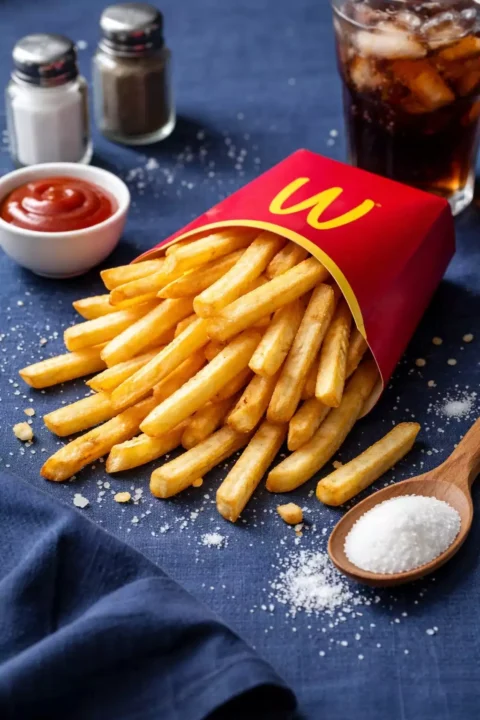
McDonald’s Fries
Double-fried with a sugar water soak. Yes really. Trust the process. McDonald’s french fries are arguably the most iconic fast food item ever created, and the homemade version requires a multi-step pr
Ingredients
- 4 large russet potatoes
- 8 cups cold water
- 2 tablespoons sugar
- 1 tablespoon corn syrup
- oil for frying (peanut or vegetable)
- fine salt
Method
Step 1: Cut and soak
-
Peel the potatoes and cut into 1/4-inch thick matchsticks. Dissolve sugar and corn syrup in cold water. Submerge the fries and refrigerate for at least 30 minutes — up to 2 hours is better. Drain and pat completely dry with paper towels. This drying step is critical — wet fries splatter and don’t crisp.
Step 2: First fry (low and slow)
-
Heat oil to 300°F. Fry the potatoes in batches for 5 minutes. They’ll be soft and pale — this is correct. You’re cooking the interior. Remove to a wire rack and let cool for at least 10 minutes. For even better results, freeze the par-fried potatoes for 20-30 minutes.
Step 3: Second fry (hot and fast)
-
Heat oil to 375-400°F. Fry the potatoes again in batches until golden brown and crispy, about 3-5 minutes. Remove to paper towels and season immediately with fine salt while they’re still glistening.

Off the Galley Mike
Mike — Off The Galley
Six years as a Navy cook on submarines and destroyers, feeding 130 sailors from a galley the size of your bathroom. Now I cook the same big-flavor, no-nonsense food for my family of four — and share every recipe here. No culinary school. No fancy plating. Just real food that works, tested on the toughest critics afloat and the pickiest ones at home.
McDonald’s Fries — Double-Fried, Sugar Water Soaked, Yes Really
Double-fried with a sugar water soak. Yes really. Trust the process. McDonald’s french fries are arguably the most iconic fast food item ever created, and the homemade version requires a multi-step process that seems excessive until you taste the result. The sugar water soak, the first fry at low temperature, and the second fry at high temperature — each step serves a purpose, and skipping any of them gives you ordinary fries instead of extraordinary ones.
The original McDonald’s fries were cooked in beef tallow, which gave them an incredible savory depth. They switched to vegetable oil in 1990 and added “natural beef flavoring” to compensate. At home, you can add a tablespoon of beef tallow to your frying oil for that nostalgic flavor, or skip it entirely for a vegetarian-friendly version.
Why the Sugar Water Soak
This is the step that sounds crazy and is absolutely essential. Soaking the cut potatoes in a solution of cold water, sugar, and a little corn syrup does two things: it removes excess starch (which prevents gumminess) and the sugar promotes even browning during frying. Without it, your fries will be pale and limp. With it, they turn golden and crispy with that distinctive McDonald’s color.
Ingredients
4 large russet potatoes, 8 cups cold water, 2 tablespoons sugar, 1 tablespoon corn syrup, oil for frying (peanut or vegetable), fine salt.
How to Make Them
1
1Cut and soak
Peel the potatoes and cut into 1/4-inch thick matchsticks. Dissolve sugar and corn syrup in cold water. Submerge the fries and refrigerate for at least 30 minutes — up to 2 hours is better. Drain and pat completely dry with paper towels. This drying step is critical — wet fries splatter and don’t crisp.
2
2First fry (low and slow)
Heat oil to 300°F. Fry the potatoes in batches for 5 minutes. They’ll be soft and pale — this is correct. You’re cooking the interior. Remove to a wire rack and let cool for at least 10 minutes. For even better results, freeze the par-fried potatoes for 20-30 minutes.
3
3Second fry (hot and fast)
Heat oil to 375-400°F. Fry the potatoes again in batches until golden brown and crispy, about 3-5 minutes. Remove to paper towels and season immediately with fine salt while they’re still glistening.
The Beef Tallow Option
Before 1990, McDonald’s fried everything in beef tallow, which gave their fries an incredible savory depth that people still talk about. You can add 2 tablespoons of beef tallow to your frying oil for that nostalgic flavor. Beef tallow is available at most butcher shops or online. If you can find it, try one batch with and one without — the difference is remarkable. The tallow adds a richness and subtle meatiness that vegetable oil simply cannot replicate. It’s the reason older people insist McDonald’s fries “used to taste better.” They’re right. They did.
The Perfect Cut
Cut your potatoes into 1/4-inch matchsticks. Uniformity matters — fries that are different thicknesses cook unevenly. A mandoline slicer with a julienne attachment makes this fast and consistent. If cutting by hand, take your time and aim for sticks about the diameter of a pencil. Too thin and they burn during the second fry. Too thick and the interior stays raw while the outside browns.
Salt Timing
Season immediately after the second fry while the fries are still glistening with oil. The moisture on the surface acts as glue for the salt. Use fine salt, not coarse — fine salt distributes more evenly and sticks better. If you wait even 2 minutes, the fries cool and the salt bounces off instead of sticking.
Why Russet Potatoes
Russets are high-starch, low-moisture potatoes — exactly what you need for fries that are fluffy inside and crispy outside. Yukon Gold and red potatoes are waxy and low-starch, which makes them great for roasting but terrible for frying. Don’t substitute.
The Temperature Matters
The double-fry works because each temperature serves a different purpose. 300°F cooks the potato through gently, creating that soft, almost mashed-potato interior. 375-400°F dehydrates the exterior and creates the crispy shell. Use a thermometer — guessing the temperature is why most homemade fries fail.
Serve With
These go with everything in our copycat collection: smash burgers, Big Macs, Chick-fil-A sandwiches. Dip in Chick-fil-A sauce or Cane’s sauce for the ultimate fast food experience at home.
Make-Ahead Strategy
Complete the first fry and freeze the par-cooked fries on a sheet pan. Once frozen, transfer to freezer bags. When ready to eat, fry directly from frozen at 375-400°F until golden. This is exactly how McDonald’s does it — par-fry at the factory, freeze, ship, and finish-fry at the restaurant.
Frequently Asked Questions
Can I bake these instead?
You can toss them in oil and bake at 425°F for 25-30 minutes, flipping halfway. They won’t be the same as deep-fried, but they’re decent. The sugar soak still helps with browning.
Why are my fries soggy?
Three likely causes: not enough drying after the soak, oil temperature too low, or crowding the fryer. Fry in small batches and use a thermometer.
How long do these keep?
Eat immediately. Fries don’t reheat well. If you must, oven at 400°F for 5 minutes is better than microwave, which turns them into rubber.
The Science of the Double Fry
This isn’t a gimmick — it’s food science. The first fry at 300°F cooks the potato interior, turning the starch into a fluffy, creamy texture. But the exterior at this temperature is still soft and pale. After resting (and ideally a quick freeze), the moisture in the surface evaporates. When you hit it with the second fry at 375-400°F, the dry exterior immediately crisps and turns golden while the interior stays fluffy. This is exactly what McDonald’s does in their factories — par-fry, freeze, ship, finish-fry.
The Beef Tallow Question
Before 1990, McDonald’s fried everything in beef tallow. That’s why older generations remember the fries being better. You can add 1-2 tablespoons of beef tallow to your frying oil for that nostalgic flavor. Beef tallow is available at most grocery stores in the cooking oil aisle or from your butcher. If you can’t find it, a tablespoon of bacon grease mixed into vegetable oil gives a similar richness. For a fully vegetarian version, just use peanut oil — it has a high smoke point and a neutral-to-slightly-sweet flavor that works well.
Cutting Consistently
Uniform cuts matter. Thick fries take longer to cook, thin fries cook faster — if your fries are mixed sizes, some will be limp while others are burnt. Aim for 1/4-inch matchstick cuts. A mandoline slicer makes this fast and consistent. If cutting by hand, focus on keeping the thickness uniform even if the lengths vary.
The Salt Timing Rule
Season the fries the INSTANT they come out of the oil, while they’re still glistening with a thin layer of oil. The oil acts as glue for the salt. Wait even 30 seconds too long and the surface starts to dry, and the salt just slides off. Use fine salt, not coarse — coarse salt is too heavy and falls off. Fine salt sticks to the surface and distributes evenly.
Air Fryer Alternative
If deep frying feels like too much effort (fair), you can apply the same sugar water soak to air fryer fries. Soak, dry thoroughly, spray with oil, and air fry at 400°F for 15-18 minutes, shaking every 5 minutes. They won’t be identical to McDonald’s, but the sugar soak still helps with browning and the result is noticeably better than unsoaped air fryer fries. For the full McDonald’s experience though, the double-fry in oil is the way.
Portion Math
Four large russet potatoes yield about 4 servings of fries — roughly equivalent to 4 large orders at McDonald’s. The cost of 4 potatoes is about $2. Four large fries at McDonald’s costs about $16. Even factoring in oil and salt, you’re saving $12+ per batch. And you’re eating actual potatoes without the 19 ingredients that McDonald’s uses.
More From Off The Galley
Smash Burgers · Chick Fil A Sandwich · Big Mac Copycat · Wendys Frosty · Texas Brisket
Off the Galley Mike
Mike — Off The Galley
Six years as a Navy cook on submarines and destroyers, feeding 130 sailors from a galley the size of your bathroom. Now I cook the same big-flavor, no-nonsense food for my family of four — and share every recipe here. No culinary school. No fancy plating. Just real food that works, tested on the toughest critics afloat and the pickiest ones at home.